
University of Wisconsin-Stout’s game design programs continue to climb in the rankings among their peers around the nation, rising to No. 6 in the Midwest and No. 17 among all public universities in the United States, according to the latest figures published by Animation Career Review.
UW-Stout held steady on another Animation Career Review leaderboard, but that’s only because it couldn’t climb any higher: The game design programs were ranked No. 1 in Wisconsin for the eighth consecutive year. UW-Stout also placed No. 11 nationwide among universities offering game design-related B.F.A. degrees.
“Our program has matured beyond its ‘startup’ phase and is consistently producing industry-standard work, as evidenced by how many of our senior capstone games go on to be published on the Steam and Epic Games platforms,” said Associate Professor Kim Loken, program director for
B.F.A. game design and development – art.
Loken said UW-Stout’s multiple game-design related degree programs – which also include a B.S. computer science with a game design and development concentration and a B.S. game and media studies – set Wisconsin’s Polytechnic University apart from its peers.
“Because we offer game dev-focused B.F.A. and B.S. degrees in parallel, our students achieve depth in their roles to maximize effective collaborations in the five semesters in which they take courses in which they make games together in ever-larger team structures,” Loken said.
Students build award-winning games
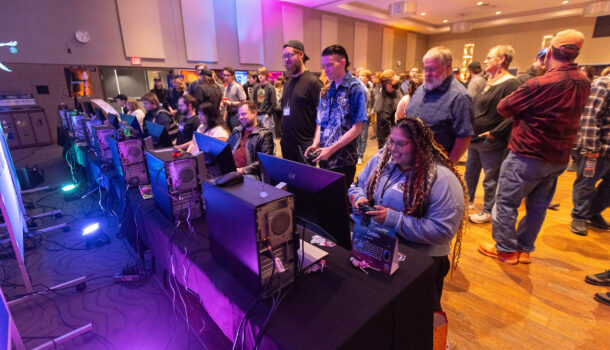
Game design courses culminate in the senior capstone, which simulates an industry environment as students create games in teams. These games are on display each semester at the Stout Game Expo (SGX), western Wisconsin’s largest game developer exhibition, which was held May 7.
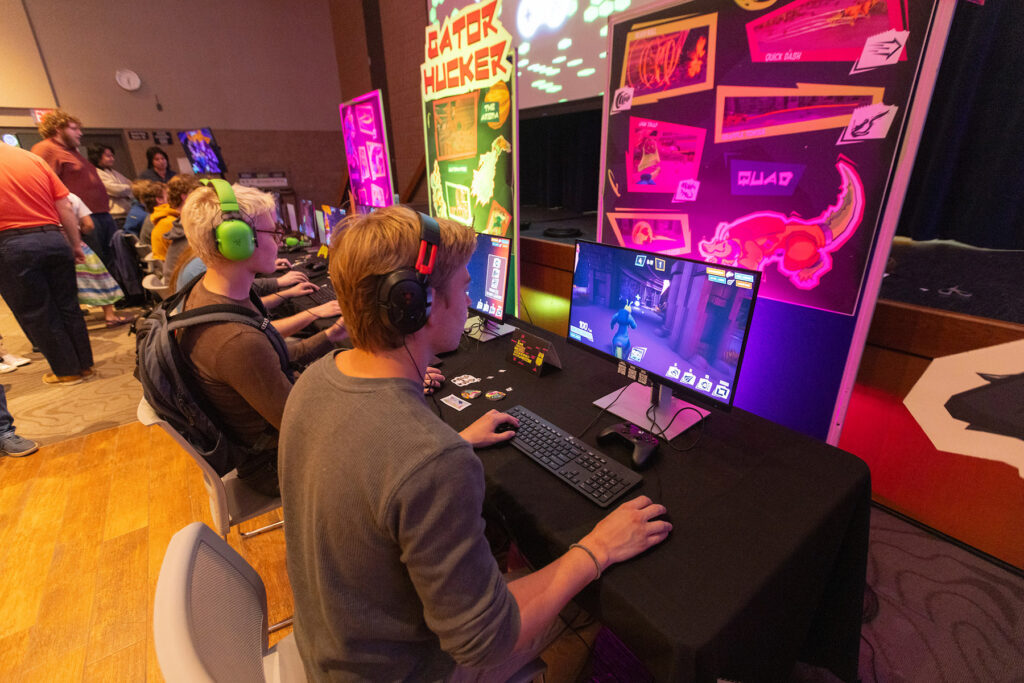
Among the award-winning games at SGX was Gator Hucker, in which players brawl as alien alligators with wacky abilities. The game, which won the Audience Award, grew out of a running joke in class about a game in which gorillas threw alligators in space, explained senior Space Goettl. A game design and development – art major with a computer science minor, Goettl wore many hats during the game’s development, including leading the character art team, serving as a technical animator and heading marketing efforts.
“One really important thing the program does is that all of the interdisciplinary game design classes put you on a team where you basically function as your own indie studio, so by the time you graduate you’ve already independently published three video games,” Goettl said. “Because you’re always doing group work (and group work with people outside your individual areas of expertise, no less), you develop really important soft skills through the process that can apply to any job, not just the games industry.”
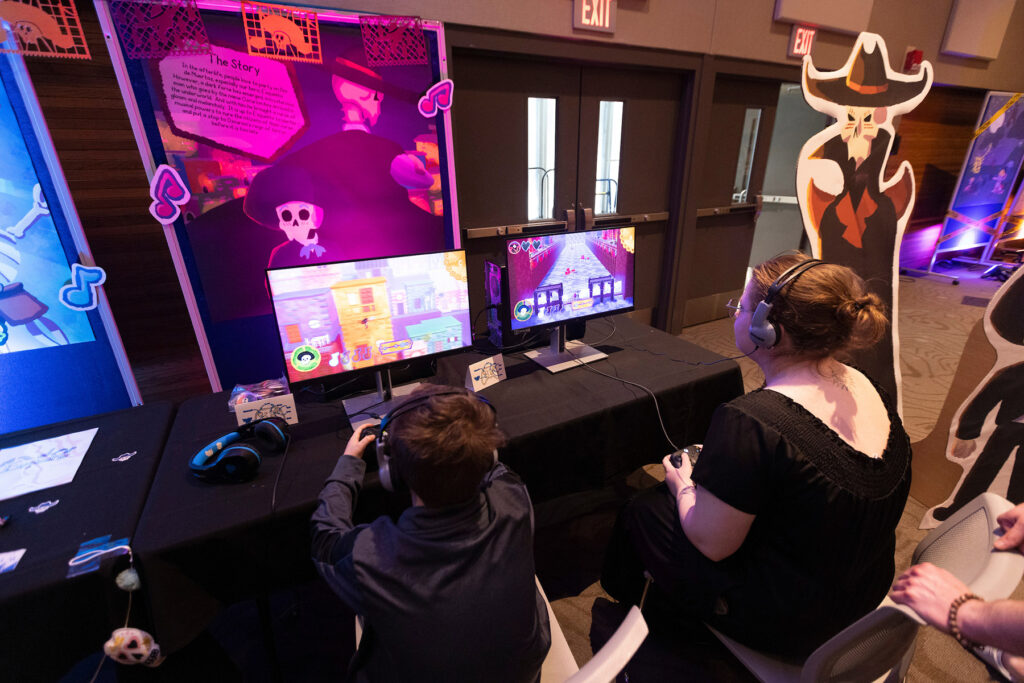
The award for Best Production at SGX went to Esquelito, a colorful, musical game set in the Mexican underworld. Players become Esquelito, a little skeleton who spreads joy through music, moving through levels while staying on beat.
The game was inspired in part by Mexican Day of the Dead traditions as well as the Disney film “Coco,” said senior Alex Colmenares, a B.F.A. game design and development – art major who served as game designer, VFX artist and illustrator for Esquelito.
“A big challenge that the team faced was ensuring that the game was not disrespectful in the way it represented Mexican culture,” said Colmenares, whose own heritage includes Mexican roots. “Another challenge was proper game balance. We wanted to market our game to children, so to that end we wanted to design a game that would be easier for kids. But sometimes things would come out to be way too difficult or way too easy! It was a lot of work to properly tune the game’s difficulty.”
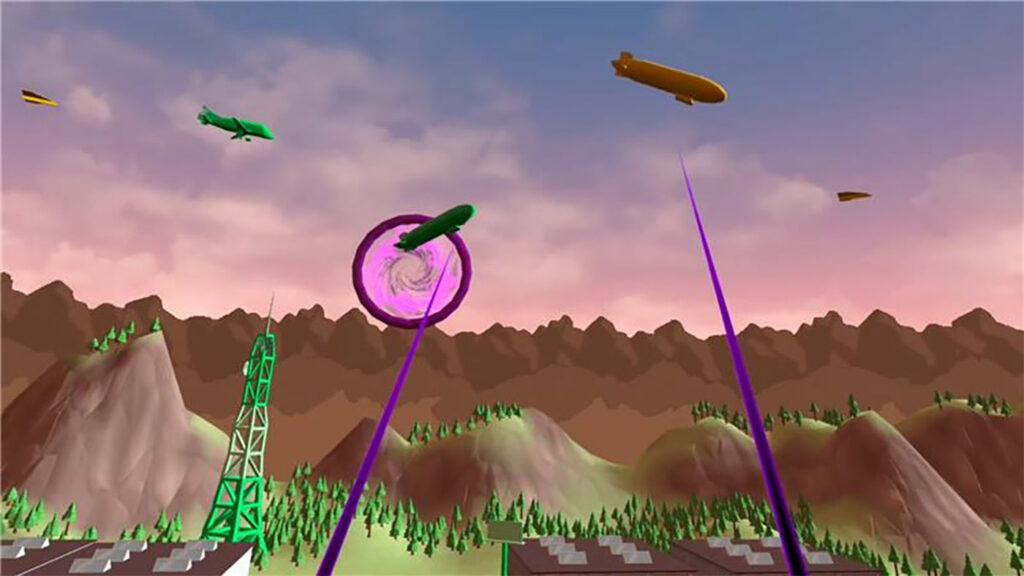
Another big hit at SGX was Aeromancy, a virtual reality in which players take the role of wizards who must land airplanes on the correct runway using magic gauntlets. At SGX, Aeromancy won the Audience Award for games created in the junior-level Exploratory Game Design course.
“The use of virtual reality enhances the chaotic, frantic nature of the game and allows the player to access that child-like headspace of playing with toy airplanes,” said Assistant Professor Michael Tetzlaff. Aeromancy is the third VR game exhibited at UW-Stout in recent years, and the first developed entirely by junior-level undergraduates.
Junior-level students in the Exploratory Game Design course showcased a two-player racing game called Driven to Madness, which featured a monstrous motorcycle engine as one of the game controllers. Professor Andrew Williams explained that one player drives a motorcycle on a racetrack while calling out to the other player, a mechanic, who must make adjustments to the engine to avoid obstacles.
“The game focuses on communication as each player has access to different types of information and needs to share it to play. This was an ambitious, high-risk project because it has very complex problems to solve and the team needed to learn a lot of skills independently,” said Williams, who added that the game won the Most Innovative Gameplay award at SGX.
Game design programs among top in nation
Overall, UW-Stout had a banner year in the Animation Career Review rankings, placing at No. 36 among all public and private universities in the United States. The rankings are driven by academic peer assessments, graduate employment outcomes, and metrics of program scale and institutional performance, including faculty size, retention rates, and graduation rates.
Games created by UW-Stout students have made an impression far beyond campus. Last November, a student-built submarine game called Dread Not was honored as best student entry at M+DEV, the largest game industry conference in the Midwest, which drew 1,500 attendees to Madison.
And the graduates who created these games are finding careers in their chosen field: According to UW-Stout’s most recent survey, 97% of game design and development – art graduates were employed or continuing their education within six months of graduating. Recent game design alumni have landed jobs with the likes of Activision, Raven Software, Fantasy Flight Games, Pixel Farm and Trek Bikes.
The game design and development – art program is part of the School of Art and Design, one of the largest public art schools in the Midwest. The School of Art and Design also offers bachelor’s degrees in animation and digital media; game and media studies; graphic design and interactive media; illustration; industrial and product design; interior design; studio art; arts administration and entrepreneurship; fashion design and development; and video production, and an M.F.A. in design.
Photos
Audience members test student-designed games at the Stout Game Expo (SGX) on May 7, 2026.
Stout Game Expo attendees play Gator Hucker, one of the student-designed games.
One of the games at SGX, Driven to Madness, featured a game controller designed to look like an engine.
A scene from the student-designed virtual reality game, Aeromancy.