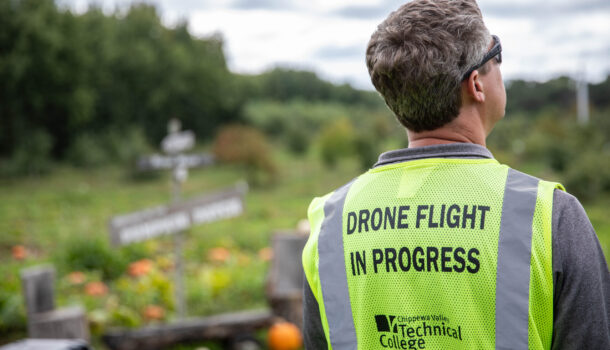
A blanket of snow covers Leffel Roots Apple Orchard just south of Eau Claire, but that doesn’t mean Chippewa Valley Technical College drone students’ work is done.
Throughout the fall, a group of students traveled to the quaint orchard in Eau Claire County, where hands-on learning met real-world agricultural needs. The partnership provides students with practical experience in collecting and processing aerial imagery. In turn, the work helps orchard owners Jim and Laura Leffel explore new ways drones can support their business.
This is the fourth course in CVTC’s drone program, following completion of recreational flying, commercial licensing, and mapping and modeling, said instructor Shawn Creviston, who heads the drone program at the College. For several weeks, they flew drones over the same sections of the orchard to track week-to-week changes in crop growth.
After each flight, they uploaded their imagery for processing using two different tools: a formula-based program and an AI-powered platform that delivers deeper analysis.
“It’s nice getting out to the field and seeing what we actually do instead of only looking at examples in the classroom,” said Brynn Daniels, 21, of Spooner.
The hands-on environment has helped each student find their path.

For Mitchell Lehman, 20, of Bruce, the program was a chance to shift career directions.
“I wanted to find something new, and drones sounded interesting. I asked ChatGPT for ideas and got into it from there,” he said. “These classes have made me so much more comfortable flying drones and understanding the processing side of things.”
Daniels works in the auction industry and said the skills she’s building will immediately benefit her workplace.
“We really need someone in-house to take drone footage instead of paying for it, so getting certified is important,” she said.
Another student in the class, Mitchel Peterson, 21, of Menomonie, said drones offer a way to stay connected to something he has always loved.
“I always liked flying, but aviation had too many rules and regulations. With drones, I can still fly without all of that,” he said.
The orchard itself has become an ideal training ground. The Leffels have managed the property since 2015 and have steadily expanded it, incorporating features like pumpkins, apples, and community amenities. Jim Leffel took drone classes at CVTC years ago and welcomed the chance to support the program when the class needed a new place to fly.
“We’ve always been into education. That’s why we partnered with CVTC,” he said.
He’s also eager to use drone data to benefit the orchard. The students’ imagery feeds into an advanced platform introduced through Maverick Drone Systems. With high-resolution sensors and AI analysis, the technology can identify weeds, leaves, and specific plant variations. Leffel sees enormous potential.
“Eventually I want to identify sandburs and weeds so a spray drone can target just those plants instead of spraying everything,” he said. “If drones can help us avoid broad spraying, it saves money, uses fewer chemicals, and saves us time searching for weeds.”
The students collected data in the fall and continue to work on testing to determine what the imagery can reveal and how accurately the software can pinpoint different species. Starting earlier in the growing season will enable the orchard to act on results, making informed decisions about spraying or plant management in real-time.
For CVTC students, the orchard partnership offers more than a class assignment. It’s an opportunity to strengthen their skills, support a local business, and demonstrate how drone technology is reshaping industries from marketing to agriculture.