
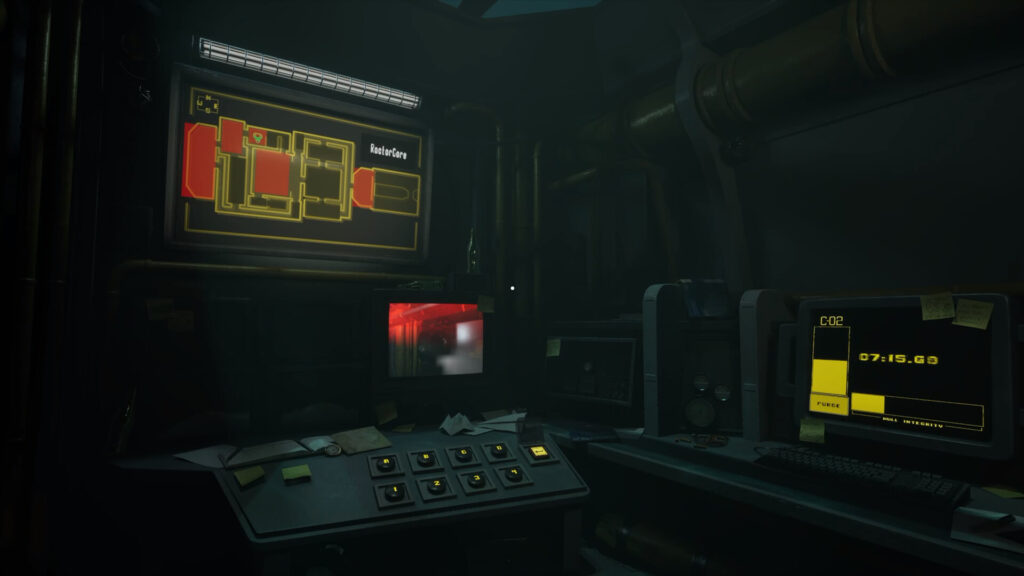
The creators of a computer game about a doomed submarine had a real-life sinking feeling last May as the date of the Stout Game Expo (SGX) approached. After months of work on the claustrophobic, cooperative game Dread Not, the team of 15 University of Wisconsin-Stout students were facing problems with their code which had broken an otherwise polished game.
It was a stressful situation, recalled Ryan Thiede, the game’s art manager and original pitch creator. Not only was the game a capstone project for these soon-to-be graduates, but it was scheduled to be shared with hundreds of attendees at SGX, the region’s largest game expo.
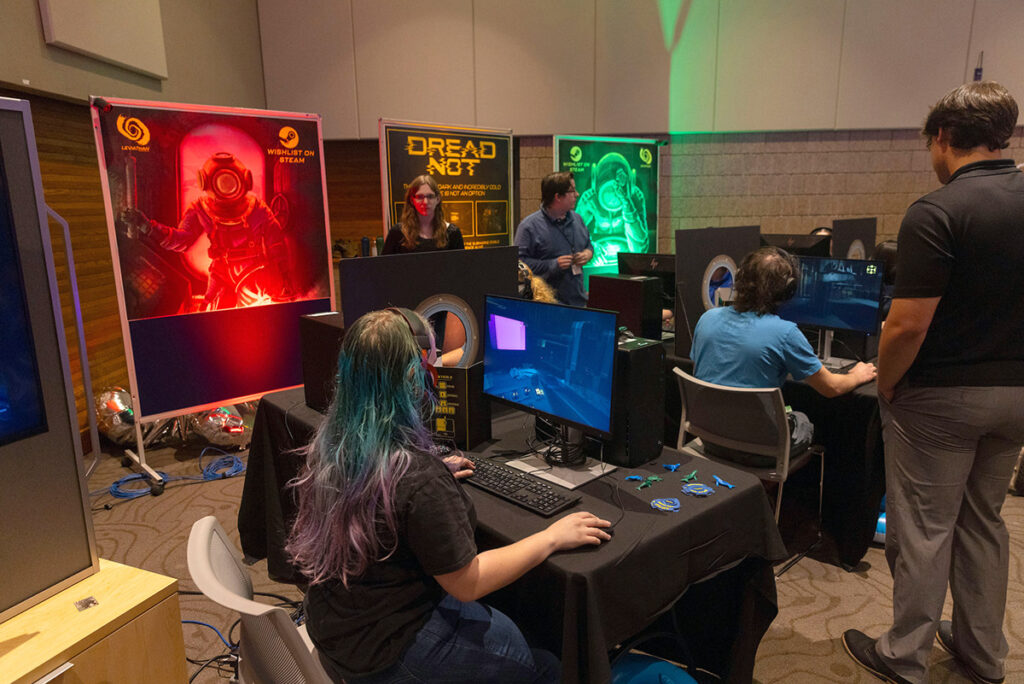
Fortunately, what Thiede described as “late-night heroics” from lead coder Ben Rowan and gameplay coder Jacob Richardt got the two-player networked game working, and it went on to win two awards, Audience Choice and Best Art, at the spring event.
“It’s a crazy story, but it says something for the tenacity and drive from the people on the team,” added Thiede, who graduated in May with a degree in game design and development-art. “We went from an unplayable game to an award-winning capstone project, essentially, overnight.”
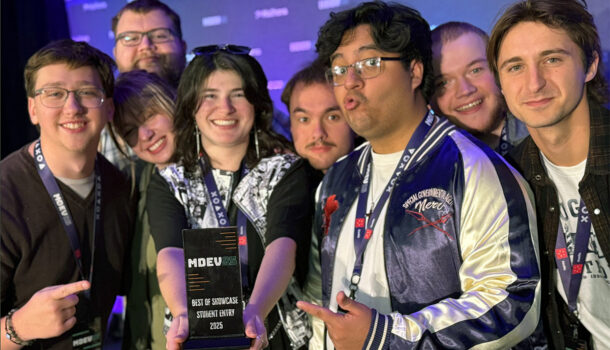
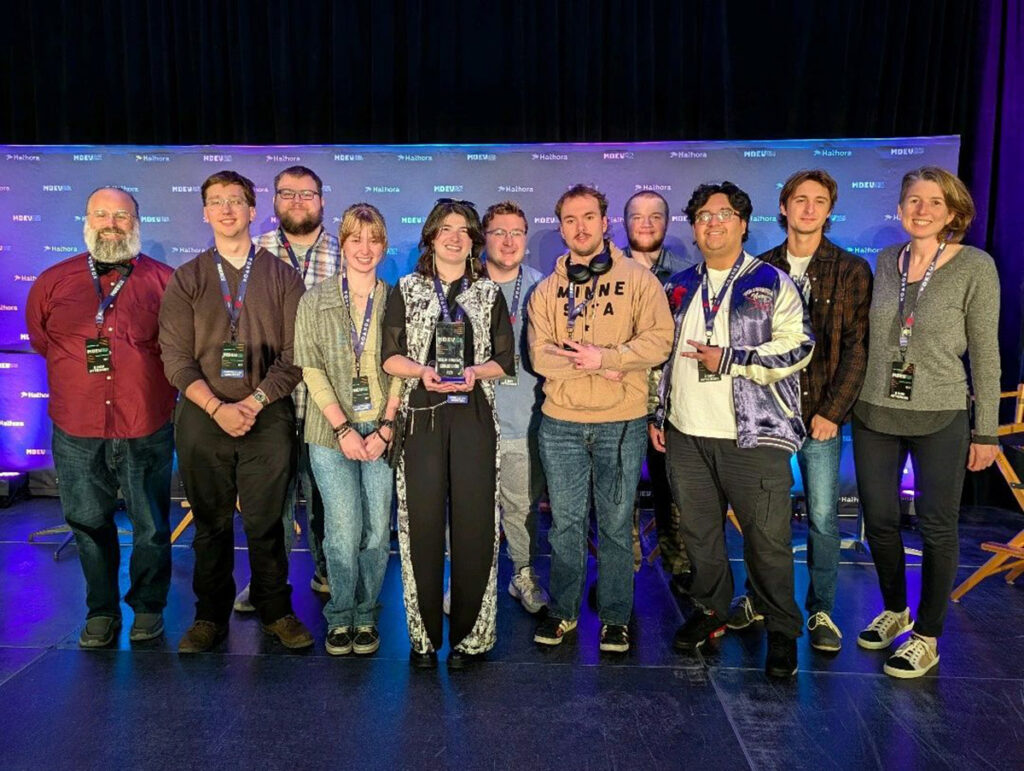
Six months later, the Dread Not team received more accolades, winning the award for best student entry at M+DEV, the largest game industry conference in the Midwest, which drew 1,500 attendees to Madison Nov. 7-8 and featured two days of expert-led panels and speakers, game showcases, workshops and networking. M+DEV served as a platform for the creativity, skill and scholarship generated by UW-Stout’s globally and nationally ranked game design program.
At least 90 M+DEV attendees were either current students, alumni or faculty of UW-Stout. These included two faculty members and three alumni who made presentations and several dozen alumni who exhibited games, including three teams of recent graduates who shared recent capstone projects: Dread Not as well as Tubular!! and Mega Dimension Ripper 9000.
The latest student-built games will be ready for players at the fall semester SGX, which will run 6-9 p.m. Wednesday, Dec. 10, in the Great Hall of Memorial Student Center on the UW-Stout campus.
Expo showcases top-ranked program
M+DEV, which is organized annually by the Wisconsin Games Alliance, bills itself as “the hub for indie and AAA developers, industry professionals, students and casual gamers.” The event’s sponsors include UW-Stout, whose undergraduate game design program is ranked No. 5 in the Midwest and No. 24 in the world by Princeton Review.
Unique among public universities in Wisconsin, UW-Stout offers bachelor’s degrees in both the art and science of gaming: namely the B.F.A. game design and development-art and the B.S. computer science (game design and development concentration). Graduate students in the M.F.A. design program also can choose a game design focus.
UW-Stout is also home to the new B.S. game and media studies program, the only game-oriented media studies program in Wisconsin. The university also offers an esports coaching minor and was the first public university in Wisconsin to launch a varsity esports program.
M+DEV provides a valuable opportunity for the UW-Stout students, faculty and alumni to connect with each other and the game development community at large while gaining visibility for their projects, said Professor Andrew Williams.
“Anytime you can get people to interact with your work, you are reaching your intended audience, and you learn how to improve your craft,” Williams said. “Game development is an incremental process and the more opportunities you have to talk with your players and build that community around your project, the better!”
Williams, whose game art has previously won awards at M+DEV, returned this year as a speaker. His presentation — evocatively titled “Building the Plane While Flying It: The Rapid Development of an AI-Powered Educational Game Series” — highlighted how a company he works with, immersionED, is using AI to create engaging history content for elementary through high school students. Through roleplaying as fictional historical characters in 70 scenarios, students can develop their historical thinking skills, Williams said.
“In the industry, AI use is highly varied as there is no ‘standard practice’ yet since we are just learning how it could be beneficial to speeding up workflows,” Williams said. “We may be moving into a new phase of its use as the industry is starting to understand it is not a solution to every problem.”
Other M+DEV presenters included Michael Tetzlaff, assistant professor of computer science, and UW-Stout alumni Jacob Schwitzer, B.S. computer science (game design & development concentration); Mary Benetti, B.F.A. game design & development-art; and Sam Baeseman, B.F.A. game design & development-art.
Winning game an ‘intense experience’
Thiede, who now works as a 3D artist for Las Vegas-based Game Breakdown, conceived the idea that became Dread Not as a capstone project and pitched it to his fellow students last year. His goal was to create something that could be enjoyed by players of all ages — including people who don’t consider themselves “gamers” — and that fostered collaboration.
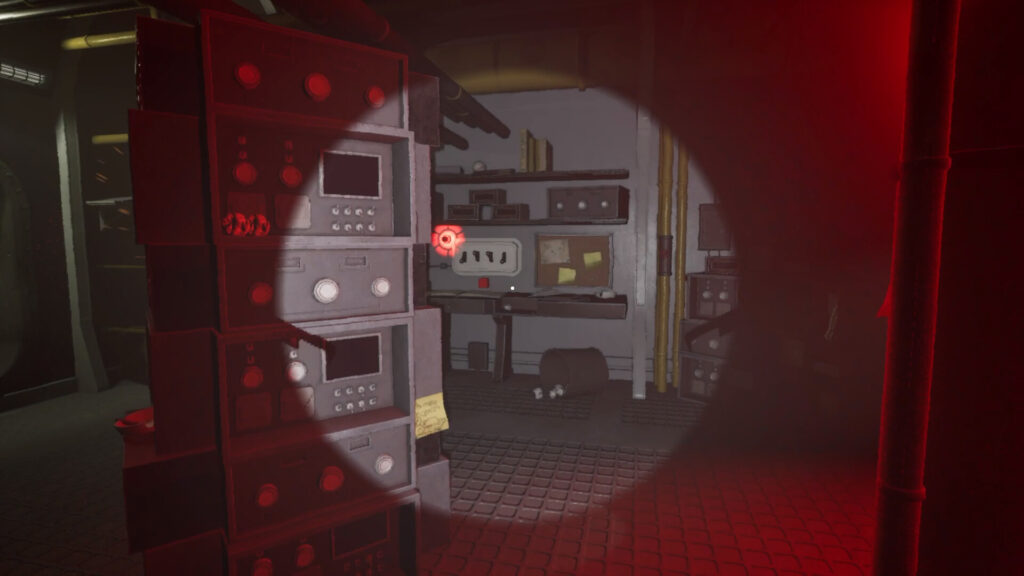
“It was a project that was meant to immerse and connect two people through an intense 10-minute experience,” Thiede said. The two players, a pilot and a mechanic, must cooperate quickly and effectively to solve multiple problems — namely dwindling oxygen levels and an angry sea monster — and reach the surface before their submarine’s oxygen runs out.
And just as the game players must cooperate to succeed, so did the 15 UW-Stout students who created the game. At the helm was Sarah Ziebarth, who as the game’s producer kept the project on schedule, balancing the team’s workload while also completing her own lighting design and project marketing responsibilities.
Ziebarth, who graduated in May with dual majors in game design and development-art and computer science, praised how the students cooperated over the course of two semesters to overcome obstacles, add features and optimize the game.
“The game design and development program at Stout has always done an exceptional job of making sure both sides of development (art and computer science) work together in multiple classes throughout their college careers and thus learn the important skills of teamwork and communication,” Ziebarth said.
Thiede agreed, adding that UW-Stout’s program allowed him to explore many different paths in the game design field. “The layout of courses grants you time to experiment to see what you like, as well as plunge deep into what you may choose to focus on: 2D art, 3D art, VFX, lighting, animation, technical art, etc.,” he said. “All are possible at Stout.”
Thiede said he was pleasantly surprised when, while chatting with industry friends at M+DEV, he was suddenly whisked to the stage to receive an award for Dread Not.
“Genuinely, I pictured my career to be filled with people telling me what to do, and me just doing it,” he reflected. “I never imagined having an idea of mine make it this far. The reason it has is because of the people I worked with at Stout — the professors, but more importantly, my teammates.”
Associate Professor Kim Loken, who was co-instructor for the capstone course alongside Professor Seth Berrier, praised the Dread Not team for their success.
“Unlike the held-together-by-duct-tape world of their game, this team was high-performing and well-organized with clear goals, excellent communication and exceptional craft,” Loken said. “Their networked game, damage system and puzzle design challenged the programmers, and the artists excelled with a rigorously researched and realized 3D environment, enriched by a diegetic backstory and wry character details. We’re proud of the continued commitment they’ve shown to their work, polishing it over the summer for a Steam release and continuing to exhibit their work for direct engagement with players.”
Since its June release on Steam, the largest digital distribution platform for PC games, Dread Not has been downloaded more than 250,000 times.
Other members of the Dread Not team included B.F.A. game design and development-art majors Zach Adler, Eleanor Berg, Gabe Anderson, Elaine Kelling, Samuel Lambert, Ben Moon, and Jon Wolfe, and B.S. computer science majors Guinness Bruce, Graham Higdon, Victor Mondragon, Nathan Morgan-Shimmin, Jacob Richardt, and Ben Rowan. The team also collaborated with 11 students from the Berklee College of Music in Boston, who contributed original music, sound effects and voice talent.
Photos
Professor Seth Berrier, far left, and Associate Professor Kim Loken, far right, stand with some of the UW-Stout alumni who created Dread Not at the M+DEV conference in Madison. (Submitted photo)
UW-Stout game design alumni celebrate their winning game, Dread Not, at November’s M+DEV game conference in Madison. (Submitted photo)
In the game Dread Not, shown in this screenshot, players must cooperate to survive in a doomed submarine. (Submitted image)
The pilot room in the student-created submarine game, Dread Not. (Submitted image)
Visitors play Dread Not, a game created in a UW-Stout game design capstone course, at the spring 2025 Stout Game Expo (SGX).