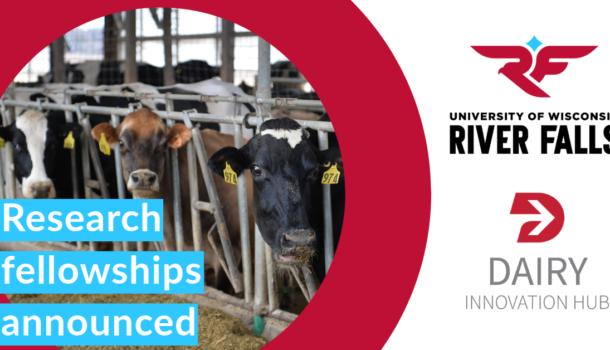
The University of Wisconsin-River Falls College of Agriculture, Food and Environmental Sciences (CAFES) recently awarded five faculty research fellowships to expand dairy-related research through the Dairy Innovation Hub initiative. The selected faculty will lead projects across the Hub’s four priority areas: stewarding land and water resources; enriching human health and nutrition; ensuring animal health and welfare; and growing farm businesses and communities.
Funded by a $7.8 million annual investment from the state of Wisconsin, the Hub brings together research and development efforts at UW-Madison, UW-Platteville and UW-River Falls. Its goal is to keep Wisconsin’s $52.8 billion dairy industry globally competitive while promoting economic, environmental and social sustainability. Since launching in 2019, the Hub has supported nearly 300 projects across the three campuses.
Faculty research fellowships provide temporary support for ongoing faculty, allowing them to focus on specific research projects. This support includes funding for related project expenses and helps ensure faculty have the time and flexibility needed to carry out research while maintaining their teaching responsibilities.
In addition to research outcomes, these projects create hands-on learning opportunities for students to work directly alongside faculty on field studies, laboratory analysis and technology development, gaining experience with real-world data, modern equipment and industry-relevant challenges.
The following UW-River Falls faculty fellows were selected for funding:
Captive bolt placement effects on tissue depth and thalamic damage in dairy cattle cadavers
Scientist Karly Anderson from the Humane Handling Institute, together with co-investigator Kurt Vogel from the Animal and Food Science Department, is refining practices for humane stunning and euthanasia in dairy cattle. By studying how bolt placement affects critical brain regions, the project aims to identify techniques that consistently ensure rapid and effective unconsciousness. The results will provide science-based guidance to veterinarians, farmers and meat processors, improving animal welfare and strengthening confidence in humane livestock practices. Read the full profile.
Farm GPT (herd pilot): Custom LLM advisor for dairy cow health monitoring with precision data for bovine management
Assistant Professor Magdy Abdullah Eissa from the Engineering and Engineering Technology Department is developing an AI-powered tool designed to help farmers turn farm data into real-time decisions. “Farm GPT” integrates information from sensors and monitoring systems and delivers simple, conversational guidance on herd health and management. By making complex data easier to use, the project supports a shift toward more proactive, precision-based dairy management that improves efficiency, animal welfare and farm performance. Read the full profile.
Molecular epidemiology of pathogens isolated from subclinical mastitis cases in Wisconsin dairy cows
Assistant Professor Maria Jose Fuenzalida from the Animal and Food Science Department is addressing subclinical mastitis, a hidden but costly infection that reduces milk quality and production. Using DNA fingerprinting, the project will track how mastitis-causing bacteria spread within and between herds and evaluate how they respond to treatment. This work will give farmers and veterinarians clearer insight into prevention and control strategies, leading to healthier cows, improved milk quality and more efficient use of antibiotics. Read the full profile.
Export market concentration and dairy price risk: Implications for Wisconsin farm businesses
Assistant Professor Mohammad Hasan Mobarok from the Agricultural Economics Department is examining how reliance on a small number of export markets affects price stability for Wisconsin dairy farmers. Products like cheese and whey depend heavily on global demand, and disruptions in a few key markets can quickly ripple through milk prices and farm income. By combining data analysis and economic modeling, the project will identify conditions that increase financial risk and highlight strategies that help farmers, processors and lenders plan more effectively. The results aim to strengthen risk management and improve long-term resilience across the dairy supply chain. Read the full profile.
Tracing the legacy: Baseline assessment of potentially toxic trace metals under long-term manure application
Assistant Professor Ashani Thilakarathne from the Plant and Earth Science Department, along with co-investigator Holly Dolliver, is investigating how long-term manure application influences the buildup of trace metals in soil, crops and water. By establishing baseline data, the project will help identify early signs of metal accumulation and inform nutrient management decisions. The findings will support farmers in maintaining soil health, protecting water quality, and sustaining productivity over time. Read the full profile.